
Sanctions for Attempting to File a Piece of Paper?
10/11/11
 [more]
The PACER and CM/ECF programs have revolutionized the practice of bankruptcy law. Thanks to PACER, I can download a document filed in almost any district in the country for the low price of $.08 per page (soon to go up to $.10 but still cheap). Thanks to CM/ECF, I can meet a deadline to file a pleading from home at 11:59 p.m.
The purpose of PACER and CM/ECF is to offer greater public access to government records. According to the Administrative Office of the U.S. Courts:
The Case Management/Electronic Case Filing (CM/ECF) system is the Federal Judiciary's comprehensive case management system for all bankruptcy, district and appellate courts. CM/ECF allows courts to accept filings and provide access to filed documents over the Internet.
CM/ECF keeps out-of-pocket expenses low, gives concurrent access to case files by multiple parties, and offers expanded search and reporting capabilities. The system also offers the ability to: immediately update dockets and make them available to users, file pleadings electronically with the court, and download documents and print them directly from the court system.
The Dark Side
While these electronic access programs make the system more transparent, democratic and user-friendly there is also a dark side. Mandatory e-filing can be burdensome on the casual filer, such as a state court practitioner who rarely ventures into bankruptcy court. Many courts have adopted procedures to assist pro se parties and occasional filers. Some examples include allowing paper filing with court permission, allowing documents to be submitted on disk or be scanned at the clerk's office and allowing proofs of claim to be filed without a CM/ECF password and login.
A Scary Order
However, in an extreme case, a court in Pennsylvania has charged an attorney a $150 "processing fee and sanction" for filing a paper document. You can see an image of the order below (I apologize for the poor copy).
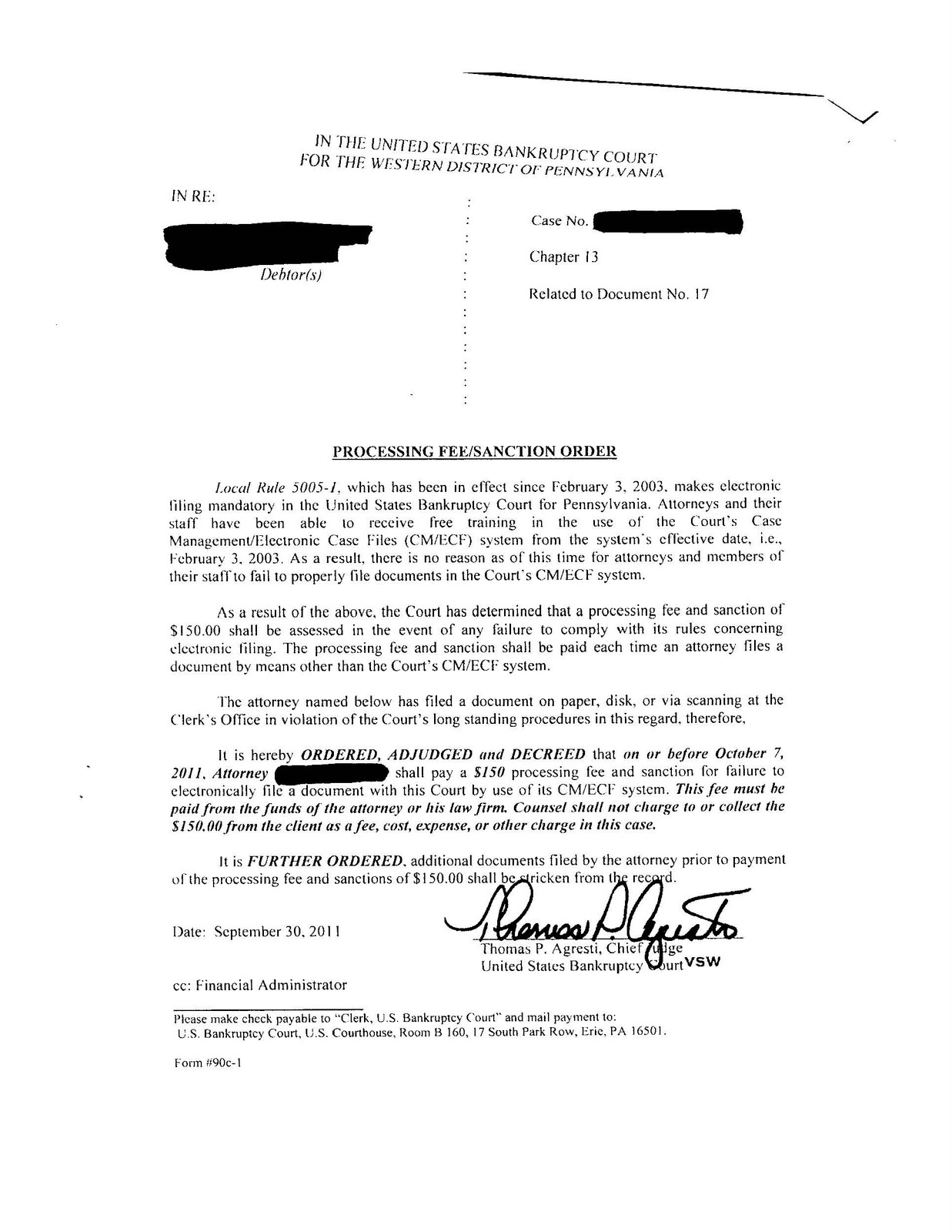
In pertinent part, the order states:
(T)he Court has determined that a processing fee and sanction of $150.00 shall be assessed in the event of any failure to comply with the rules concerning electronic filing. The processing fee and sanction shall be paid each time an attorney files a document by means other than the Court's CM/ECF system.
The attorney named below has filed a document on paper, disk or via scanning at the Clerk's office in violation of the Court's long standing procedures in this regard, therefore,
It is hereby ORDERED, ADJUDGED and DECREED that on or before October 7, 2011, Attorney (name redacted) shall pay a $150 processing fee and sanction for failure to electronically file a document with this Court by use of its CM/ECF system. This fee must be paid from the funds of the attorney or his law firm. counsel shall not charge to or collect the $150.00 from the client as a fee, cost, expense. or other charge in this case.
Why It's Bad
This order concerns me for (at least) three reasons. The first is a matter of due process. I have read the local rules of the Bankruptcy Court for the Western District of Pennsylvania. There is no provision for a processing fee or sanction for attempting to file a document other than electronically. Indeed, the Court's procedure manual explicitly states that submitting a document on disk or scanning it at the clerk's office is allowed. Because the order does not distinguish between filing on paper, disk or by scanning at the clerk's office, the order punishes behavior that is expressly allowed by the court's procedures.
Second, I have trouble finding a justification for the order. It is my understanding that individual judges do not have the authority to set fees. While the judicial conference of a circuit may authorize certain miscellaneous fees, I don't think individual judges have this power. I also don't believe that this qualifies as sanctionable conduct. It doesn't fall within Rule 9011 and it is my understanding that the court's inherent authority to sanction is limited to cases of bad faith.
Finally, I have a philosophical objection to the order. One of the stated purposes for the Bankruptcy Code was to break up the incestuous "bankruptcy rings" where local attorneys, trustees and judges had an overly cozy relationship to the exclusion of outsiders. The E-Government Act of 2002 was intended to make government records more accessible. This order violates both of these purposes. It brings the judicial power of the United States down on an attorney who made a procedural mistake. While the amount of the sanction is minimal, it is still a court-imposed sanction which must be reported in some cases. A careful review of the Court's rules and procedures would not have disclosed the peril (although the attorney would have seen that something called e-filing was mandatory). Besides the shock of receiving a judicial reprimand by return mail, the order also sends the message that outsiders practice here at their peril.
Admittedly, bankruptcy is a technical and difficult area of the law. Through the Bankruptcy Abuse Prevention and Consumer Protection Act of 2005, Congress made it much more challenging for the average practitioner to wander into bankruptcy court representing a consumer debtor. Nonetheless, the courts, as public servants, should use their power to make the courts more accessible rather than less. This order is offensive.
- Feeds Categories: